
Introduction
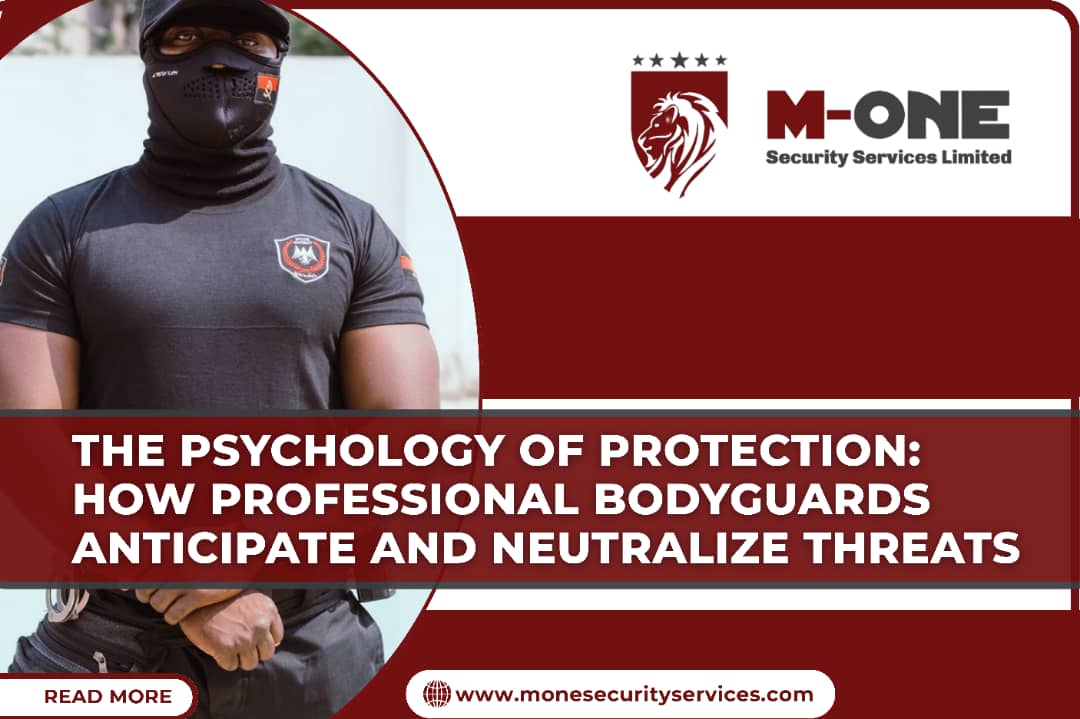
When people think of bodyguards, they picture big, imposing figures in dark suits and shades, but in reality, the most effective protectors don’t rely on muscle alone, their true strength lies in psychology. Professional bodyguards are trained to read environments, anticipate intent and quietly shape outcomes so that threats never materialize in the first place.
In Nigeria’s fast changing cities where security risks range from crowd surges to targeted attacks, the ability to think ahead and de-escalate is just as important as physical defense. Here is how bodyguards anticipate and neutralize threats using mindset, behavior analysis, environmental design and psychology as their strongest weapons.
1) The Protector’s Mindset:
Bodyguards don’t sit around waiting for trouble, their work is rooted in probabilities and patterns. The best protectors cultivate situational awareness as a daily habit, maintaining a mental 360 degree map of their surroundings, they know who is present, who is missing, what feels normal and what seems off, their approach favors anticipation over reaction, instead of scrambling once danger appears, they preemptively close the gaps an attacker might exploit. Above all, they carry a strong bias for de-escalation, physical intervention is the last resort, their first line of defense is presence, positioning, and psychology. A protection team, for instance, treats crowded markets and music festivals as high variance zones. Their assumption isn’t that violence will erupt, but that chaos itself creates opportunities for opportunistic threats. By anticipating this possibility, they design safe routes and contingency plans that keep their clients protected without drawing unnecessary attention.
2) Reading People:
Threats often give themselves away before any action is taken, professional bodyguards train themselves to read behavioral baselines, a quick mental picture of what normal looks like in any given setting, and then zero in on the subtle deviations. Sometimes it’s in the micro behaviors, clenched fists, shallow breathing, a fixed stare, pacing or too many repeated glances, but context is everything. For instance, a vendor at an event kept asking about a VIP’s arrival time, on the surface, his curiosity seemed harmless, but his nervous gestures and inconsistent answers told a different story, the bodyguards decided to quietly re route the VIP and it was later uncovered that the man had been working with a group planning to breach the perimeter.
3) Designing the Environment for Safety:
Protection work often looks like nothing more than routine logistics, but beneath it lies careful psychology, the smallest adjustments can neutralize the biggest risks. Bodyguards design controlled entry and exit flows to cut down on unpredictability, position vehicles and teammates so sightlines are always covered and keep multiple fallback routes ready in case of congestion or confrontation. A hotel learned this lesson the hard way after a near miss involving a VIP guest, the management quietly restructured its entire arrival protocol, staggered drop offs, entrances shielded from public view and quick staff briefings for scheduled events. To guests, the changes looked seamless, but to security professionals, they represented a dramatic reduction in risk without the heavy handed feel of security theater.
4) Technology as a Tool, not a Crutch:
Modern protection is a partnership between psychology and technology, but the human mind always stays in charge. Risk analytics pull in data from events, routes and even public chatter to help bodyguards calculate the probability of threats before they materialize. Secure communications, whether through encrypted radios or simple backup walkie talkies, ensure the team stays connected even when networks fail. Also, surveillance tools from CCTV to temporary cameras can highlight anomalies, but it is the trained eye of a professional that decides whether those signals matter. In cities where privacy concerns and legal gray areas are growing, many firms now consult legal advisors before rolling out advanced surveillance. The goal is to protect without crossing ethical or legal boundaries proving that discretion is as important as detection.
5) Neutralizing Threats without Force:
The best neutralizations rarely make headlines because they look so ordinary, professional bodyguards follow a quiet ladder of response, escalating only when absolutely necessary. Sometimes, it’s as simple as presence and positioning, stepping between a client and a suspicious individual to deter intent before it grows. If tension rises, calm but authoritative words are often enough to de-escalate hostility. When a situation threatens to spiral, the priority shifts to containment and extraction, moving the client discreetly to a pre-planned safe zone without creating spectacle. Physical action, when unavoidable is always a last resort, minimal, proportionate and immediately followed by medical care and incident reporting.
Conclusion
The psychology of protection is less about brute force and more about quiet mastery. The best bodyguards think like chess players, controlling space, anticipating moves, and shaping perception so violence never becomes the only option. That mix of psychology, preparation, and discretion is what keeps principals safe, not muscle, but the mind behind it.